
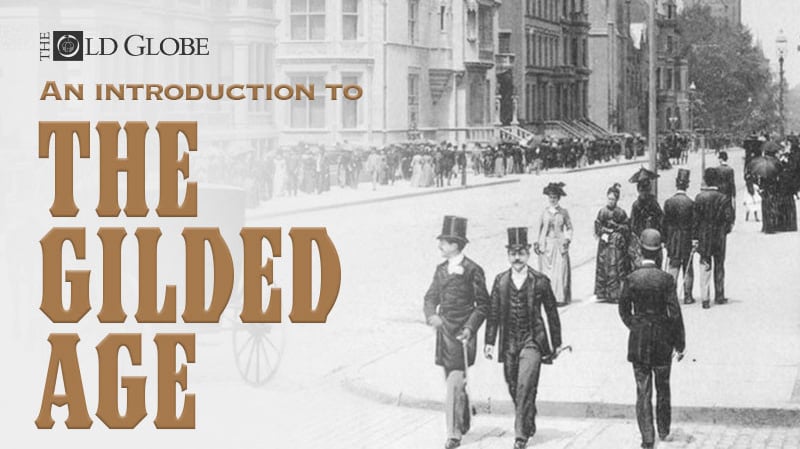
An Introduction to The Gilded Age
The term “Gilded Age” comes from Mark Twain and Charles Dudley Warner’s 1873 satirical novel The Gilded Age: A Tale of Today, which caricatured the rampant greed, gross materialism, and political corruption of the day. The story held a mirror up to the reality of the era: a thin, shiny veneer masking serious social unrest. The Gilded Age was an era of American history defined by dichotomy: abject poverty in the face of extreme economic growth, political machines versus populist movements, monopoly kingpins staving off burgeoning labor unions, and the opulence of new world high society amid the harsh reality of the newly immigrated.
Though historians do not agree on an exact start and end date, the Gilded Age commonly refers to the latter three decades of the 1800s. During this time, industry in the post–Civil War United States witnessed a meteoric boom, with rapid expansion led by entrepreneurial pioneers eager to actualize the promise of the self-made American.
Steel, oil, petroleum, tobacco, textiles, banks, and railroads grew extensively, with titans such as John D. Rockefeller, Cornelius Vanderbilt, J.P. Morgan, and Andrew Carnegie making their fortunes and immortalizing their legacies. To some, they were captains of industry, championing the American Dream, pushing the economy into exciting new territories, and solidifying the U.S.’s footing as a financial and industrial powerhouse. To others, they were robber barons, growing rich off the backs of immigrant laborers, prioritizing capital income over ethical business practices, and disregarding their consumers and their competition in a pursuit of success by any means necessary.
Dewey Arch, New York City.
In response to this unprecedented capital gain, the wealthy American upper class began to participate in “conspicuous consumption,” the lifestyle coined by economist and sociologist Thorstein Veblen in which consumers intentionally buy goods of higher quality or in excessive quantity to flaunt their status to both their peers and the lower classes. Castle-like estate homes, elaborate wardrobes, lavish parties, and exotic foods were all symbols of success sought by the new-moneyed industrialists to establish their place in society. It was also used to compete with the lavish “old money” dynasties, whose wealth and hierarchy dated back to the days of the American Revolution or even to European fortunes, and who were hesitant to accept the new wave of overnight millionaires into their social stratum.
The role of women in society also saw a significant shift during the Gilded Age. Becoming the champion of a charitable cause provided a new social realm in which women could have a more visible and functional role in public life. Upper-class women turned their attention to fundraising and social activism, financially supporting a myriad of grand arts, culture, and outreach projects and thus ushering a new wave of philanthropic powerhouses into high society. Louise Whitfield Carnegie, wife of steel tycoon Andrew Carnegie, is noted for being one of many such pioneers, playing an influential role in creating Carnegie Hall in New York City, as well as being an active donor to organizations like the American Red Cross and the YWCA, even after her husband’s death.
This philanthropic spirit of the Gilded Age, however, was not always as altruistic as it may initially seem. Often these capital investments were used as a way for titans to circumvent increased wages for their working-class laborers. In his 1889 article “The Gospel of Wealth,” Andrew Carnegie argued that funds must be “properly administered” for society to reap the benefits. Rather than increasing direct pay for employees—which he claimed would be wasted on the common man’s “indulgence of appetite”—he funded projects he and his peers deemed beneficial to the progress of civil society, effectively keeping money out of the hands of the lower classes while maintaining a reputation as a benefactor to the public good.
So while a mass influx of immigration brought wave after wave of laborers into the workforce from all across Europe, they resided in cramped tenement buildings in densely packed urban hubs like New York City while working for pennies on the dollar in unsafe and unregulated conditions. This disparity between the wealthy and the poor planted the seeds for the first labor unions and labor strikes around the turn of the 20th century.
Despite nearly 150 years between then and now, the realities of the Gilded Age feel all too reminiscent of our contemporary struggles. On the heels of recent political controversies and corruptions, union strikes in multiple industries, ever-stratifying income inequality, and continued disenfranchisement of immigrants, women, and minority communities, the troubles plaguing society in the late 1800s feel shockingly familiar in 2023, setting the stage for an ever-timely revisit to Edith Wharton’s The Age of Innocence.