
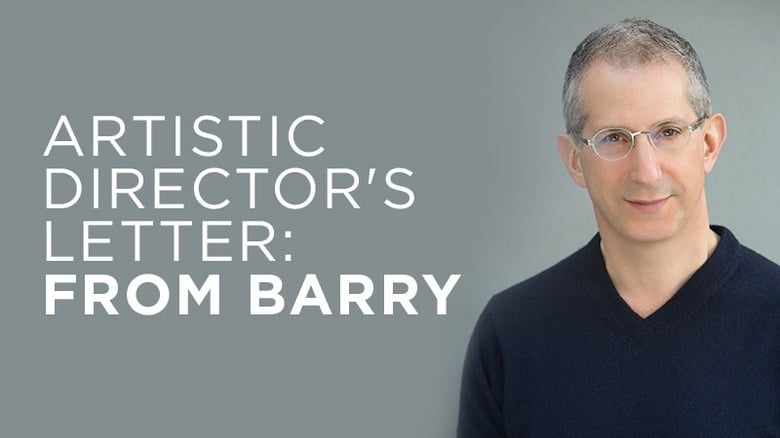
Artistic Director's Letter: From Barry: House of India
Food is a powerful expression of culture and identity, and playwrights seize on its metaphoric richness. Dinners and snacks in plays as dissimilar as Long Day’s Journey into Night, The Importance of Being Earnest, The Glass Menagerie, and August: Osage County attest to the vivid theatricality of a table setting. In these works, food cements family bonds, welcomes strangers, and forges community. Shakespeare, too, exploits the potent stage dynamics of eating: the stone soup in Timon of Athens, the harpy banquet in The Tempest, and the murder-tinged pastries in Titus Andronicus all memorably attest to the psychological and sociological forces that roil humans sitting down to a meal.
Our play, House of India, understands the extraordinary theatrical potential of food every bit as thoroughly as the classics I’ve listed above. The gifted Deepak Kumar draws on his memories of learning recipes from his mother, as well as family visits to the mom-and-pop Indian joint at the local strip mall, and conjures a down-on-its-luck Indian restaurant suffused with the sights and scents of South Asian cooking. Kumar tells a gentle, even sweet story of a family undergoing the same generational transition as their restaurant, and he centers his drama on children torn between a sense of duty to their parents on the one hand, and devotion to their own dreams on the other. And then he elevates the play to a higher thematic plane, placing these family and individual concerns in the context of a larger—perhaps the largest—American issue: assimilation, and the pressure it places on our country’s immigrant communities.
With tremendous imagination and wit, Kumar posits that assimilation has a culinary analogue: fusion cuisine, and he suggests that this is in some ways a fundamentally American phenomenon. Into what we used to call the melting pot, he stirs ingredients from many cultures, and the dishes that emerge are simultaneously specific to their own origins and also, delightfully, brand new. Indeed, the play ultimately, and to me provocatively, asks whether assimilation is a kind of American inevitability. Eventually, in this society of immigrants, won’t, say, Indian and Mexican cultures merge together? And if they do, would an Indian taco be a “Frankenstein Food,” or the kind of fabulous culinary chimera that wins a reality show competition? In the play, ambitious young chef Jacob knows his answer, and so does traditional Ananya. The stakes are higher for Vikram and Vaidehi, and as they work through this dilemma, balancing the old with the new, the personal with the communal, and the dominant culture with the immigrant one, we learn something fundamental about how Americanness gets formed.
Deepak Kumar is a local, which makes it a special thrill for the Globe to be home to this special play’s premiere. Another thrill is the Globe debut of director Zi Alikhan, who is cutting a bold swath through the American theatre and dazzling audiences across the country. These are the artists who will shape the next generation of this country’s theatre, and we’re proud of the work they’ve brought us. Their team of designers and their expert cast, including Globe veterans and new faces, bring passion and talent to their work, and we’re grateful to them as well. Finally, we are thankful to the many theatregoers in our region’s South Asian communities who in recent seasons have been remarkably supportive of the Globe’s work telling stories of their complex, rich, and beautiful culture … and tonight, its surpassingly delicious food!
Thanks for coming. Enjoy the show.
Barry Edelstein is the Erna Finci Viterbi Artistic Director of The Old Globe.
Any feedback on tonight’s show or any of the Globe’s work?
Email Barry at HiBarry@TheOldGlobe.org and he’ll get back to you!
