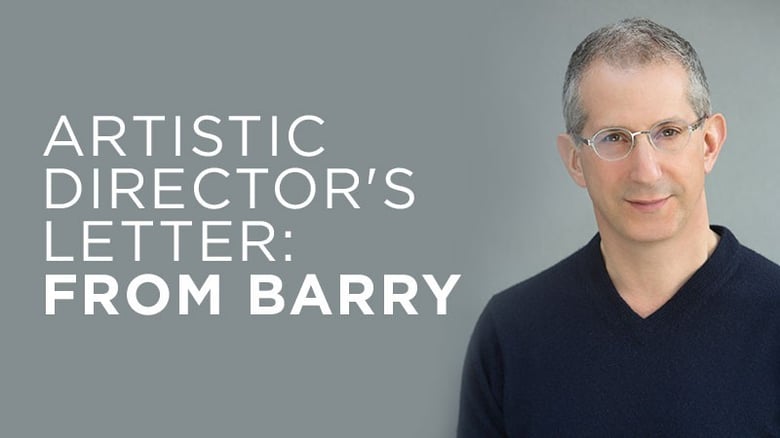
Artistic Director's Letter: From Barry: All's Well That Ends Well
It’s the obligation of a great Shakespeare theatre to produce all 36 of this remarkable writer’s works, but we know that our audiences understand that some of the plays might be more produced than others. Over the Globe’s 90 years there’ve been something like a dozen Midsummer Night’s Dreams, maybe ten of Romeo and Juliet. But Cymbeline? I think three. Henry VI, Parts One, Two, and Three? Exactly one.
All’s Well That Ends Well was last produced on our Festival Stage in 2007, though it had the special honor of inaugurating our Globe for All community tour when we launched it in 2015. I directed that one, because the play is one of my favorites. I think it’s underrated and deserves its share of the bright light usually shone on As You Like It or Othello. It’s complex, for sure, and even strange in many ways. But its reputation for being difficult is undeserved–an unfortunate legacy of the unfairly-applied, nineteenth century genre label, “Problem Play.” I don’t find it problematic at all, except in the narrow sense that its every loose end isn’t quite wrapped-up when it’s over. In the 19th century that was a problem. In the 21st, it’s a strength.
Written late in Shakespeare’s career, All’s Well shares many attributes in common with the late plays: The Tempest, The Winter’s Tale, Antony and Cleopatra, and others. All of them are concerned with the inexplicable, the ineffable, the wondrous, the miraculous. At the end of his mighty writing life, Shakespeare became obsessed with the things he couldn’t comprehend, the things that defied simple explanation. In All’s Well, he is drawn to conundrums: why does Helena love someone who so clearly doesn’t want her? Why is it so hard for the older generation to comprehend the younger? How is it that human existence teeters so precariously between fortune and failure, and between health and decay? Shakespeare being Shakespeare, he doesn’t proffer simple answers. Instead he revels in contradictions and oxymorons. “The web of our life is of a mingled yarn,” he tells us, “good and ill together.” That’s it. Simple. You want to know about life? It’s a mixed bag. Good luck to you. Perhaps we could yearn for more from the author of Hamlet and King Lear. But maybe, from the writer of those two plays, “life is complicated” isn’t a bad epilogue.
A play of this density requires a sure hand at the tiller. I’m so very pleased that my old friend Peter Francis James—everyone calls him PFJ—accepted my invitation to direct it. Peter and I met while working on Kevin Kline’s Hamlet at New York’s Public Theatre a whopping 35 years ago. And we’re still at it! He is a consummate stage actor: elegant, intelligent, surprising, witty. His voice is one of the treasures of the American stage, and his gift for Shakespeare is pretty much unparalleled in his generation of actors. He’s also an important figure in American actor training. For over 20 years he taught Shakespeare at the vaunted Yale School of Drama, and the students he trained have shaped our entertainment culture. They’ve also shaped Shakespeare at the Globe. Our most recent Juliet was a PFJ student; so was last summer’s Duke of York. There are very few people who can make Shakespeare’s language live as vividly as PFJ does, and it’s a real honor to support his growing directorial career by shepherding his humane and funny vision of this knotty, stunning play to San Diego.
PFJ embraced a team of designers who are close friends of the Globe and veterans of our Shakespeare Festival. He’s also put together an uncommonly brilliant cast of American Shakespeareans. An important dynamic in All’s Well is the generations it spans: there are old characters and young ones, and the sparks that fly between them are what make the play so much fun. Watching celebrated veterans like my dear friends Mary Lou Rosato and Tom Nelis mix it up with our extremely talented MFA actors is a joy and, for me, a special delight. I’m so grateful to have this special work here, and I promise it won’t be another 18 years before all once again ends well.
Thanks for coming. Enjoy the show.
Barry Edelstein is the Erna Finci Viterbi Artistic Director of The Old Globe.
Any feedback on tonight’s show or any of the Globe’s work?
Email Barry at HiBarry@TheOldGlobe.org and he’ll get back to you!