
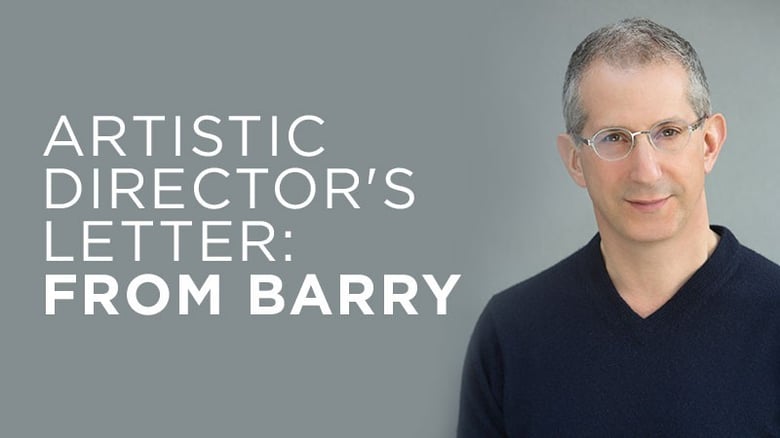
Artistic Director's Letter: From Barry: Hedda Gabler
Hedda Gabler is on a short list of plays that are the Mount Everests of the theatre, the impossible ones that artists choose to climb because they’re there. It’s a classic and it’s eternal. When there’s a theatre on Mars, Hedda Gabler will be in the repertoire.
This is so partly because of Henrik Ibsen’s stature as “The Father of Modern Drama” who brought psychological realism onto the stage and reoriented the work of playwrights in the 150 years since. It’s also because of the play itself, and its seemingly endless richness and depth.
Hedda Gabler is a story about an extraordinary woman living in decidedly ordinary surroundings. She’s looking for something more, for a life whose dimensions transcend the quotidian and the banal. But Hedda’s world isn’t interested. The small university town in which she’s settled and the marriage to which she’s agreed share an interest in shutting-down people like Hedda. For Ibsen, and for generations of interpreters since, these forces of conventionality, these powers aligned against Hedda, can be summed up in one idea: the patriarchy. Hedda lives in a world of men who keep her down, who exercise power over her, who rob her of agency, options, even free will.
A century and a half later, this remains a feminist play about the repressive powers of the patriarchy. But in our world, in which women’s lives are so very different from what they were in 1890s Norway, the play expands to consider something else. Hedda Gabler wants to know what happens to people of creativity and uniqueness in a world that sees imagination itself as the enemy. Hedda is blessed with a capacious vision, an ability to see beyond the normal. But her society forecloses originality. In such a place, idiosyncrasy must be crushed.
Erin Cressida Wilson’s new English-language version of this play crystallizes this big idea in a question that’s asked repeatedly in the play: “What kind of person does something like that?” There are people who seem to make no sense. And there are people who cannot abide the absence of sense being made. These people are the agents of Hedda’s tragedy.
Erin and I first talked about working on Hedda Gabler way back in the antediluvian era of New York in the late 1990s. Just when we were about to get started, a major Hedda appeared on Broadway, and we delayed our plans. I am delighted that all these years later the circle closes in a triumphant new adaptation that will make us all think differently about this iconic work.
Another leading artist joining this production is the Pulitzer Prize-winning composer Caroline Shaw, whose musical score manages to express both Hedda’s inner life and also the formidable forces aimed at containing it. The Globe and I are honored that she’s here.
But you can’t do Hedda Gabler without a Hedda Gabler, and we have a great one. I directed Katie Holmes in the 2023 New York production of The Wanderers, which premiered here at the Globe a few years prior. I marveled at an actor of immense imagination, charisma, kindness, and grace, and I asked if she’d ever consider bringing her gifts to the Globe and San Diego. We’re here tonight because she agreed. Her Hedda is deep, engaging, complicated; she’s simultaneously sympathetic and imperious, loving and dangerous, victim and tyrant. Katie stakes out new ground. I’m happy to publicly and fulsomely express my admiration and my gratitude.
Erin, Caroline, and Katie are but three of dozens of major artists and theatremakers working on this production. It’s a special gift in my life. Now it’s my honor and my privilege to share it with our audiences.
Thanks for coming. Enjoy the show.
Barry Edelstein is the Erna Finci Viterbi Artistic Director of The Old Globe.
Any feedback on tonight’s show or any of the Globe’s work?
Email Barry at HiBarry@TheOldGlobe.org and he’ll get back to you!