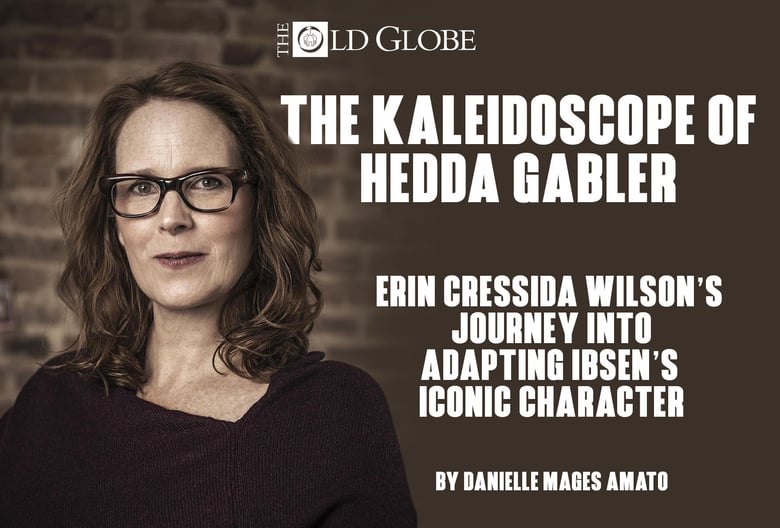
The Kaleidoscope of Hedda Gabler
Erin Cressida Wilson's journey into adapting Ibsen's iconic character.
By Danielle Mages Amato
When did you first encounter Henrik Ibsen?
My mother was an English professor at San Francisco State and – for better or worse – named me Cressida because she related so deeply to the character in Shakespeare’s Troilus and Cressida. I was raised in a world of complex female characters – both in real life and in the pages of the books that were stacked around our house. That included not only Cressida, but Nora and Hedda. These women define female desire in a way that we long to see dramatized so that we know that we’re not alone. One of my favorite Hedda lines is, “Why is it so hard to understand a young woman’s curiosity? Does it have to involve love?” It’s fascinating to watch the men surround Hedda like bees, trying to pin her down to a single definition, when in fact, she is a kaleidoscope. The kaleidoscope of Hedda.
What was it about his work that stayed with you enough to draw you back again as a playwright?
When The Old Globe asked me to adapt Hedda Gabler, I was doing a rewrite on a war film. So I was ensconced in a very different world by day – one that had little to do with my inner life. But Hedda would wake me up at night, and it was then, in the darkness, that I wrote her story. It felt like a wonderful secret, this affair with Hedda.
Though it was my dear friend and collaborator, Barry Edelstein, who finally lured me back to the theatre. There’s something both grounding and inspiring about working hand-in-hand with someone whose intellect is so vast, whose soul is so empathetic, so human. And then there’s Katie Holmes…
Katie imbues Hedda with a wisdom, revelation, but also a level of relatability that is, in my point of view, pure Ibsen. Perhaps she is the Hedda that should have been here all along and has finally arrived.
Ibsen wrote many extraordinary women. What is it about Hedda that continues to demand new language and new approaches?
A collaborator of mine once told me that any intelligent woman relates to Hedda Gabler. We think that we’re so different than the women of the 19th century, but in many ways, we aren’t. We’re still pigeonholed. Marriage can still be constricting. And the patience that our culture has for intricate women is not as deep as we think. It’s getting better, but the better it gets, the bigger the backlash. We need to hear Hedda speak in our language so that we can see that she still exists in all of us.
Can you talk about what it means, for you, to work from a “platform translation” rather than an existing English version?
Anne-Charlotte Hanes Harvey’s platform translation was exciting because it was almost as if it wasn’t in English or even Norwegian. It was a whole new arena of linguistics – like writing from the raw nerve of Ibsen. It was a puzzle, a beautiful one. I felt like I was piecing together the bits and pieces of torn language, just as George and Thea do with Lövborg’s book.
What guided your decisions as you shaped the adaptation—content, rhythm, character, tone, or something else?
Simplicity, humor, subtext, rhythm, urgency, and a certain ferocity guided my decisions. But most importantly, my decisions were driven by searching for words that a real person might utter.
What do you hope your adaptation makes newly possible for this production, for this play, or for how we think about translating canonical work more broadly?
I would like to see the percentage of plays about women get translated by women more often, if not all the time.