
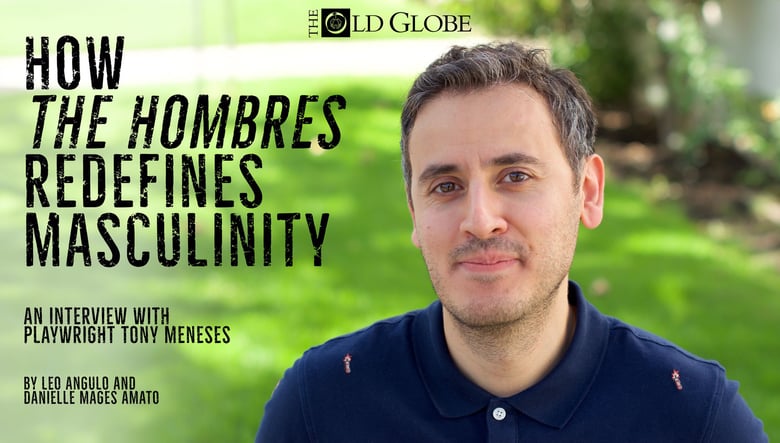
How The Hombres Redefines Masculinity
Where did the idea for The Hombres come from?
The origin for me was a personal challenge: to write an all-male play. That was the most terrifying thing I could have possibly imagined at that point in my career. I’ve usually written more female-centric works, my personal friendships are deeply skewed female, and even my favorite authors are women. So, I wanted to interrogate why that discomfort around men? Where does it come from?
Specifically what it’s about comes from the fact that I was a yoga instructor in my past life in New York. I was thinking about how yoga allowed me to improve my mental health and deal with stress, especially since I have men in my life who are bad at handling stress, particularly some of the Latino men in my family. There’s an inherent lack of self-care practice or ability to articulate difficult moments and challenges. So, I wanted to write a play about Machismo—which every culture has their version of—and an almost universal story of men struggling to communicate and be vulnerable.
The play juxtaposes two different physical spaces: yoga and construction. What interested you in the dialogue between those two worlds?
The unity between them is that they’re both physically demanding spaces. However, the perception of a yoga studio is softer than the grittiness of a construction site. I wanted the men from the construction site to initially perceive the yoga space as gendered to them. Hopefully though, the play can deconstruct even that binary alone. Of course this is not a female space; this is a space where anyone could and should be going to.
And in Julián’s perspective of the construction world, he thinks it’s this bravado, tough thing but then all the men he meets in the construction world end up eventually opening it up, including Beto, who’s a little bit more of that firecracker energy. Beto has a moment of vulnerability with Julián toward the end, too, which I think being in the yoga studio space allowed him to do.
Can you talk about the physical world of the production?
It’s a very muscular show, for sure. Since the play takes place, in part, at a construction site, we’re introducing the concept of scaffolding. It might involve a little bit of climbing or stepping up; it likely won’t be as simple as, “Hector enters,” and he walks on stage. I think there’s a thematic resonance to that.
I’m also interested in the way that both these spaces are encroaching on each other and blending together. Sometimes those two physical spaces might feel in harmony together or might feel dissonant with each other.
I’d love to talk a little bit about the switching between English and Spanish in the play. Why is bilingualism important to you?
I wanted to represent the experience of being Latino but not knowing the language, and the expectations and cultural assumptions that people unfortunately get saddled with. The play doesn’t discuss that explicitly, but it is a truthful experience. I’ve appreciated actors telling me they’ve never seen a play with someone who doesn’t know the language that isn’t about him being a traitor or not enough of something.
And then in terms of the Spanish, I hope this play helps the audience feel that they don’t need to understand the language to understand the emotional tenor of the moment, or the characterization, or the storytelling. Though most of the Spanish dialogue is translated in one way or another, there’s one moment where that doesn’t happen. I think it’s a good muscle to learn as audiences, that it’s okay, that it’s not always going to be for us.
Some of the characters contend with their desire and sexuality, but the play doesn’t position anyone as romantic interests. Why was that distinction important?
A couple of thoughts come to mind. The first is a bit academic, but there are three prongs of queer theory. There’s the homosexual, the homoerotic, and the homosocial—which is the most neglected one. Homosocial relationships are these loving relationships between men that never transgress into sex or anything beyond that. But it’s as important as the other two. I found that to be the most interesting territory to subvert expectations. For me personally, growing up there were so few stories that included gay characters. In the stories that had gay characters, a common dynamic was a straight guy is being nice to you, so that must mean that he’s interested in you, when it might be that he’s just lonely and wants a friend.
I wrote this play very actively against what you’re getting at. We all know what that homoerotic story is. It’s like a “Heated Rivalry,” which was fabulous. But we can also have a story where Julián and Miles end up together as friends.
How do you feel that Latinidad shows up in your plays?
There’s a Mexi-khovian sensibility to my work that I’m interested in because I have always been jealous of what actors in a Chekhov play get to do. I ask myself, why can’t we go internal? Why can’t we have these quiet glimpses of vulnerability and inner humanity? Why does it have to be so big and broad or a trauma narrative? So, I think I’ve been fighting against those inherited structures of what we’re allowed to tell in terms of our culture’s stories.
But I want to be truthful about our experiences with certain community issues and still have the audience on board. This play is just so funny, and the humor is integral, because it’s important to me for them to be entertained and for them to feel invited and not alienated. And yet, the play doesn’t shy away from things that are important in terms of what’s happening right now to the Latino community and to immigrants. So hopefully I’ve been able to pull off the balance between those two ideas. It’s a highwire act for sure.
Comments are turned off
The author has disabled comments for this post