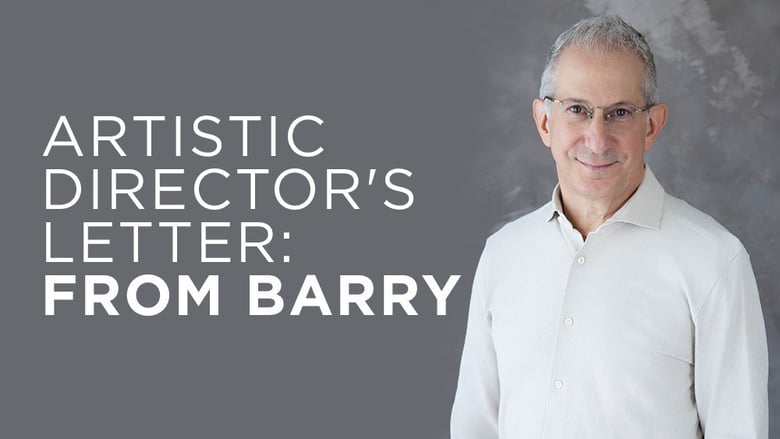
Artistic Director's Letter: From Barry: Measure for Measure
“Problem Play.” That’s the label the scholars attach to tonight’s work, Measure for Measure.
“Problem Play” is also affixed to a couple of other Shakespeare plays, including All’s Well That Ends Well, which we produced last summer, unproblematically. Labels and literature are, to borrow a Shakespeare phrase, strange bedfellows, because the greatest imaginative works defy easy categorization and slip easily away from attempts to pin them down. Scholars cleverly keep ahead of this phenomenon by inventing new labels: Shakespeare’s four late plays, for example, are variously called “The Romances,” “The Tragicomedies,” and even—surprise!—“The Late Plays.”
But “Problem Play” persists because it is not without its value as a descriptor. What it’s getting at is genre. What kind of play is Measure for Measure? A tricky question. Is it a comedy? Sort of. Is it a drama? Much of the time. It’s a social satire. It’s a sex comedy. It’s an off-kilter love story. It’s a materialist analysis of a stratified society. It has one of the most complex endings in Shakespeare, one that can be, and has been, read in wildly different ways: as comic wish-fulfillment curdled by acid, as a fantasy of social repair, as a profoundly unsettling exercise in patriarchal control, as a strange romance with justice lurking underneath it. Measure for Measure simply refuses to conform to our expectations of how a play is supposed to behave. And that’s the problem.
Except it isn’t. The very things that most befuddle the labelmakers are what theatremakers adore. In rehearsal, one can try to wrestle the play’s disjunctions into an imposed order, arranging its contradictions into something like regularity. Or one can run toward the things that don’t add up, rejoicing in a dramaturgy that is unresolved, irreconcilable, and alive. For theatre artists, when it comes to Shakespeare, a problem isn’t necessarily a bad thing.
The characters in Measure for Measure seem to be aware of the problematic nature of the play they’re in. Their language expresses the complexities and confusions of their impossible situation, and they revel in oxymorons, riddles, and double-binds. One of the play’s most famous lines, and a favorite Shakespeare quote of mine, is Isabella’s: “O, it is excellent / To have a giant’s strength, but it is tyrannous / To use it like a giant.” Strength—Isabella’s word for political power—should be used gently and compassionately, and if it’s not, then that’s an abuse. But the phrase is strange. How else could a giant use its strength, other than as a giant? Can a giant possess giant strength without behaving gigantically? Shakespeare revels in these kinds of moral puzzles, and I often wonder if that’s the “problem” that critics find so provocative.
Fortunately for Globe audiences, tonight’s production is in the capable hands of a director skilled at extracting excitement from the knottiest of Shakespeare texts. Vivienne Benesch is a director, actor, educator, and the Artistic Director of PlayMakers Repertory Company, one of the country’s most storied regional theatres. We’ve been friends and colleagues for a very long time, and it’s a special joy to welcome her here for her Globe debut. She and her colleagues have approached this play with a spirit of exploration and discovery that’s bracing and bright, and they deliver a rich and wonderful evening of Shakespeare to San Diego. I’m grateful to experience their fresh and vibrant approach to this play.
Thanks for coming. Enjoy the show.
Barry Edelstein is the Erna Finci Viterbi Artistic Director of The Old Globe.
Any feedback on tonight’s show or any of the Globe’s work?
Email Barry at HiBarry@TheOldGlobe.org and he’ll get back to you!