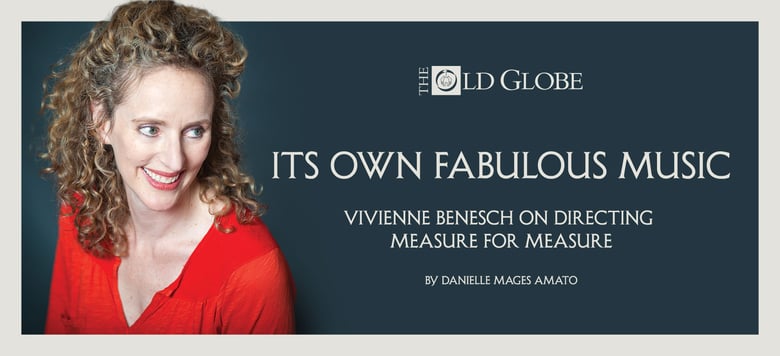
Its Own Fabulous Music
Vivienne Benesch on Directing Measure for Measure
By Danielle Mages Amato
What is your history with Measure for Measure, and what made you want to return to it now?
I encountered this play first as an actress, playing Isabella more than 30 years ago, and I fell in love with the remarkable language, the wonderful characters, and the high-stakes playground that Shakespeare gives them all to live in. It felt like a real ensemble play, the kind with no small roles.
I then directed it 20 years ago, in my first season as Artistic Director of Chautauqua Theater Company. At that time, I reveled in all of the ways in which the play examines our better and worse natures, our public and private selves—and measures them with a stark honesty and more than a dollop of poetic irony.
Returning to it now, I am—maybe surprisingly—also finding the play full of compassion, humor, and more questions than answers to the big moral issues it examines. What I’ve landed on as the point of investigation for this production is what I’m calling “the Duke’s education.” The Duke starts the play running away from his responsibilities in order to wrestle with questions like: What is good, ethical leadership? Who can you trust? Can you trust or know yourself? How does one lead through times of sweeping but undeniable change and division? The Duke winds up getting much more of an education than he bargained for.
We also have a wonderfully young cast—you often see Measure with a mature, world-wearied Duke—and I think here their youth allows us to see the characters really learn from each other. And we then learn along with them.
How do you feel about the label of “Problem Play,” as applied to Measure for Measure and some of Shakespeare’s other works?
Maybe the label “Problem Play” just means there isn’t poetic harmony in the play in a larger sense—there are still unresolved questions and unexplained choices by the end of it. But I don’t find that to be a “problem,” and in no way does it make the play less human. In fact, I find the problem plays in general to be complex and malleable in the most human ways. The thread that holds them together is the heart, purpose, and fallibility with which the characters maneuver. But I will say that Measure for Measure is one of the most tonally challenging of Shakespeare’s plays.
What do you mean by tonally challenging?
On the positive side, it means the play includes all things human. It’s not purely comedy or romance, and it is not purely tragedy. It’s highbrow one moment and lowbrow the next. To some degree, all of Shakespeare’s plays do this: the tragedies have their comic scenes, like the Porter in Macbeth, and a comedy like Much Ado About Nothing has some very tragic scenes. But the tonal shifts in Measure for Measure feel different. From scene to scene—or even within a scene—it just pivots tonally again and again, and, in a way, it makes its own music. Even if it’s not the kind of poetic harmony we’re used to—there are lots of different minor chords in this play—it’s still beautiful.
I suppose for a play that traffics in moral ambiguity and includes a tsunami of dualities, this makes sense. Characters like Pompey and Mistress Overdone are survivors, and so they may lie, do illegal things, live in what seems to be a kind of moral underworld. But in truth, they are much more honest than those who are supposedly living in the “righteous” world—often those who make the laws. And that’s what I mean about Measure being a hugely compassionate play. I feel like Shakespeare is saying: there’s good in this, and there’s good in that, and there’s bad in both, and we’re all just trying to figure it out. And perhaps forgiveness and mercy are ultimately more important to our moving forward than any kind of certainty.
Why did you set the play in Vienna of 1930—and how does that visual world inform the story?
I knew I didn’t want to set the play in our contemporary moment. For me, having some distance from the events of the play actually allows us to reflect more deeply on its present-day relevance—which is abundant. I also knew I didn’t want it to be so distant that it felt old-timey or unrelatable.
So, in the research we did, we found that Vienna had a period of time after the fall of the Habsburg Empire and before World War II, when it was known as “Red Vienna,” when it engaged in this social democratic experiment, and this first, young republic was asking: How should we govern, and how do we govern ourselves? In that period, Vienna was a social democratic city-state inside a growing conservative federal government. The historical analogies stop very quickly, but that tension felt very relevant to Measure for Measure, where we learn at the beginning of the play that there has been an extended period of leniency, a moral and sexual gray zone, and now we are seeing a conservative backlash. That felt poignant and familiar—the topics might be different, although, as we know, the biggest issues are the same. What are our rights in the face of government and the law? How does the law value women’s rights and bodies? Is the law justice? Not always. And yet, we need the law. So how should the law be tempered? All of this felt relevant to Vienna in the 1930s, to Shakespeare’s play, and to our present moment.
And of course, visually, the Viennese art, architecture, and fashion of that time were not only gorgeous, but embodied dynamic contradictions and dualities that felt really fertile for our production, setting the natural flow and romantic, sinuous lines of Art Nouveau up against Art Deco’s encroaching, energetic modernism. Scenic and Costume Designer Lex Liang and I had a wonderful time diving into that research and then figuring out how a palace and a prison could coexist in the same space and feel like physical and spiritual funhouse mirrors of each other.
Do you have any advice for the audience as they watch this production? What do you hope they might take away?
I would invite the audience into the complexity of the play: to let its contradictions and tonal shifts be part of the experience. You’ll lessen your enjoyment if you look for a single answer to the questions it raises or try to iron out its characters’ quirky, questionable choices. And what I would say is: Go on the ride. Let yourself be immersed in the story, laugh, and then cry, then scratch your head and enjoy the fact that the play might not add up harmoniously in the way you might be used to, but that it makes its own fabulous music.