
The Magic of Adaptation
Co-bookwriters Jenna Clark Embrey and Molly Beach Murphy and Illusions Designer Skylar Fox on adapting Begin Again for the stage
By Leo Angulo
The art of adaptation requires a keen understanding of the essence of a story. It also needs a strong creative vision that determines what from the original story should remain, and what should be augmented by the adapter’s own voice.
The multi-talented team that brings Begin Again to the stage balance this beautifully in their singular take on the beloved John Carney film. The co-adapters and illusions designer shared their creative journey from screen to stage.
What element from Begin Again the movie do you think the stage version most successfully maintains?
Jenna Clark Embrey (JCE) and Molly Beach Murphy (MBM): What John Carney has always so successfully captured in his work is the possibility that music—and musical talent—can be found all around us. These aren’t worlds in which the gift of songwriting or creation is confined to people that are held on a pedestal, but rather, the source of inspiration comes from music-makers we could see or encounter every day as we walk down the street. There is an accessibility and a vulnerability to that approach, to that kind of life as a musician, that we want to uplift in our version of Begin Again.
How is your writing process different when approaching an adaptation versus an original work?
JCE and MBM: When working on an adaptation, it is key to hone in on what makes the source material so successful and try to preserve that. Some works are driven by plot, others by character, some by language, and so on. Staying true to that artistic engine is the priority in a stage adaptation. John Carney’s works are really fueled by character and music, and in Begin Again, we want to keep that balance at the forefront of our process.
How do you feel that the moments of magic you’ve crafted strengthen the heart of this story?
Skylar Fox (SF): Begin Again is a story that’s meant to capture that feeling you have when you’re walking down the street with your earbuds in, and the song feels like it’s the perfect soundtrack to your life in that moment. There’s a serendipity when a piece of art perfectly captures your real life, and the magic we’re doing on stage in Begin Again is meant to be an expression of that serendipity: the way making and experiencing music can connect us to each other beyond the limits of the tangible world.
What do you feel is the biggest difference between accomplishing moments of magic on stage versus in a film?
SF: In film, an audience knows that basically anything is possible. You can understand that something is magical in film, without believing in the magic itself, because film is a visual medium. In theatre, we share the same time, space, and air as the audience, so when something breaks the rules of time and space, we feel it differently. Theatre is an imaginative medium. We create a space where imagination can allow us to see the world not as it truly is, but how we privately feel it to be.
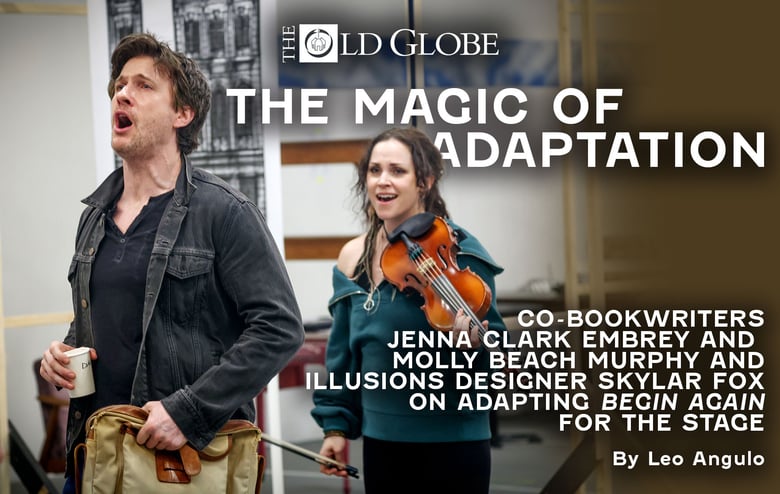
Photo: Patrick Heusinger and Erica Swindell in rehearsals for Begin Again, 2026. Photo by Sandy Huffaker.
Comments are turned off
The author has disabled comments for this post